| lithaz.org: home & art/culture events organizations publications |
| 3/29/2013 |
Lithuanian folk art: |
|
|
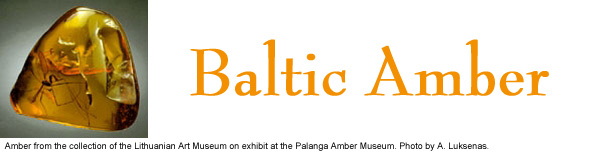
Origins"Amber (Lith. gintaras), found on the Baltic Sea shores, was and is highly treasured and is the national gem of Lithuania. It is a fossil resin" which came from the sap of "several varieties of pines. It is believed, that about 60 million years ago, these pines grew in the subtropical forest" in the present location of the Baltic Sea. "For unknown reasons these pines produced excessive amounts of" sap. "The overproduction may have been nature's method of healing natural injuries caused by storms, lightning, pests and diseases, or perhaps it was caused by a sudden change of climate." Sap "dropped to the forest ground, was embedded into the local sediments, compressed by the overlying deposits, and in time became fossilized. Numerous fragments of both plant and animal life were trapped in the sticky" sap "and thereby preserved. These inclusions make it possible to identify the plants and animal life of the period." The original location of the deposits of Baltic amber "are not known. It is believed that these deposits were removed, transported and redeposited by later movements of the sea, possible including major waves and currents, and by ancient rivers. The sandy amber formation called "blue earth" now occurs in certain places at the bottom of the Baltic Sea and the Courish Lagoon and on the Samland Peninsula of former East Prussia. Subsequent glaciers of the" Ice Ages "also transported and redeposited amber. This amber is found in Lithuania, mostly along the banks of the Nemunas, Streva, and Sirvinta rivers and the Lukstas and Plateliai lakes." |
|
Physical PropertiesBaltic amber is "considered to be the best variety of amber. It occurs irregularly as rounded nodules, drops, grains, and stalactites, weighing up to 200 g; a piece weighing more than 1 or 2 kg is rare; the largest lumps recorded are 10 and 20 kg." Baltic amber "is usually of a yellow, honey-like color, but may occur in many shades from pale yellow to dark brown. White pieces with a yellowish or bony tint are rare, and reddish, bluish and greenish tinted pieces are very rare. Some pieces of Baltic amber are transparent and clear, and others are cloudy and opaque." Amber "becomes electrically charged when subjected to friction. It burns with a bright flame and gives off a pleasant pine fragrance." |
|
Amber Artifacts"Ancestors of the present Lithuanians lived close to the Baltic Sea shores and were familiar with amber in antiquity. Prehistoric amber artifacts are found in about 60 localities in Lithuania. Their ages range from the New Stone Age to the Early Iron Age." Such artifacts are "on exhibit at the, which was opened in 1963 in the mansion of the late Count Tiskevicius, in whose family there were several collectors of amber." "Amber has been used as ornaments for men, women, horses and weapons, for cult symbols, amulets, for ceremonial purposes and as barter for foreign goods. Bartering was widespread during the Bronze Age. It was through bartering that the export of amber and amber products to central and southern Europe began. Baltic amber artifacts have been found in northern Italy and Greece." |
Gathering Amber"Amber, washed up from the bottom of the Baltic Sea and the Courish Lagoon, is collected on the shores, especially after storms, and sorting it from the seaweeds with which it is entangled. Some amber is dug out locally from" small amber deposits "along the coasts of the Baltic Sea and Courish Lagoon at Priekule, Palanga, Nida, Juodkrante and other places." "In the past fishermen waded into rough water near the shore and caught the floating amber with dip nets. Because of its danger this method has become nearly obsolete. In the Courish Lagoon, fishermen in boats pry the amber loose and catch it with a dip net of similar type." |
Amber MiningAmber "deposits were discovered in 1854 at the coastal resort of Juodkrante during dredging for a ship channel. W. Stantien, a business man from Klaipeda, became interested and organized a firm called "Stantien and Becker", which from 1860-90 obtained good raw amber by dredging and diving. About 75,000 kg were recovered annually, although during some years production amounted to 500,000 kg. In this operation special ships equipped with machines were used, and up to 500 emplyees were engaged in the work. The discovery of large amber deposits in the Courish Lagoon at the end of the 19th century caused further growth in the amber industry. There was a large demand in the world market for amber products. The craftsmen of the amber commercial centers at Palanga and Klaipeda were in competition with the craftsmen of Koenigsberg" (now Kaliningrad) "and Gdansk ("German "Danzig). Before World War I up to 500 workers were engaged in the amber industry at Palanga. They processed approximately 20,000 kg of raw amber. Similar work was carried on at Klaipeda (Memel in German). During World War I the amber industry was almost destroyed in Palanga and Klaipeda, but during the period of Lithuanian independence (1918-39) it gradually recovered. About ten artisan shops, the largest being in Palanga, Klaipeda and Kretinga, attempted to satisfy domestic and foreign demand. Several hundred people were employed, and as much as 10,000 kg of raw amber were processed each year. About half of this amount was imported from Germany. But the remnants left from the craftsmen's work, which were exported to Germany for use in chemical plants, about equaled the amount that had been imported. During World War II the amber industry was again nearly destroyed, but it recovered" again. "After the war shops for processing amber were gradually opened at Palanga, Kaunas, Klaipeda, Plunge and Vilnius. Several hundred craftsmen were engaged in the work, processing up to 10,000 kg of raw amber annually. Later, in 1963, the amber mines and pits of Palvininkai (German Palmnicken, Russian Iantarnyi) were incorporated into the Lithuanian amber industry. These century old mines, the largest in the world, are located on the Baltic Sea coast of the Samland (Sambia) Peninsula northwest of Kaliningrad. They have produced about 500,000 kg of raw amber annually. This output amounts to more than 90% of the world's amber production. Only about 20% of all amber produced is suitable for making fine jewelry and for artistic work. Pressed amber or amberoid is made from good fragments and dust and is used in the manufacture of inexpensive items, such as costume jewelry and smoking articles, and for electrical insulation. Dark, unattractive, impure pieces are used by chemical factories in the production of amber oil, amber acid, amber varnish and other products." |
Fine Amber
"Large pieces of good quality are used as gems. Amber jewelry has been worn for many centuries, especially with Lithuanian national costume, and it continues to be popular today. Personal ornaments made from amber include necklaces, pendants, bracelets, brooches, earings, rings, cuff links, and hair ornaments. Amber is used for making devotional objects, such as crucifixes, rosaries and medallions. It serves for making figurines, handles for tableware, ornaments for swords and canes, small utensils and souvenirs, various art and luxury items such as carvings, wall murals and costly reliefs. Through the ages artistic works in amber have been highly prized by royalty and high officials in Egypt, Greece, Rome, France, Germany, Russia and many other countries."
|