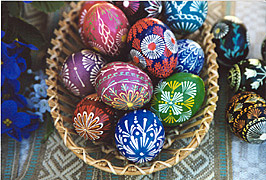
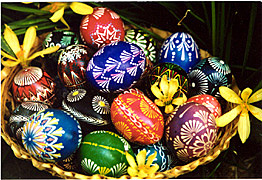
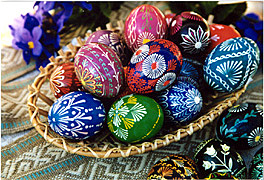
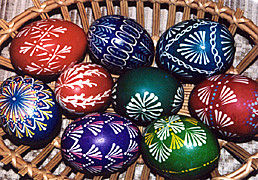
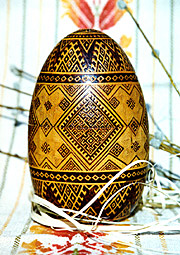
ÿþ<html> <head> <meta name="description" content="Lithuanian Easter egg decorating methods."> <meta name="keywords" content="Easter eggs, Lithuanian, decorating methods, symbolism, myths"> <meta http-equiv="Content-Type" content="text/html; charset=windows-1257"> <title>Lithuanian Easter Eggs </title> </head> <!-------------------------------------------------------------> <body bgcolor=white> <center> <!-------------------------------------------------------------> <font face="arial, helvetica" size=2> <table cellpadding=0 cellspacing=0 border=0 width=600> <tr> <td width=154> <img src="lithegg.jpg" alt="Easter egg" height=125 width=154> </td> <td> <img src="lithegg2.gif" alt="title" height=125 width=446> </td> </tr> </table> <p> <!-------------------------------------------------------------> <table border=0 cellpadding=0 cellspacing=0 width=600> <tr> <td valign=top align=left> <font size=2 face="verdana, arial, helvetica" color=green> <b>SYMBOLISM AND MYTHS</b><p> </font> <font size=2 face="verdana, arial, helvetica" color=black> The hatching of a live chicken from an apparently inanimate egg is a source of wonderment for us today, but it was even more so to the ancients. It came to symbolize creation, fertility, and life. The ancient Egyptians, more than three thousand years ago, recorded on their papyrus scrolls their belief that the egg was a gift from their most powerful deity, the sun. Ancient Assyrians, Greeks and Romans also ascribed devine origins to the life-giving egg. The epic <i>Kalevala</i> of the Finns even claims that the egg was central to the creation of the world. </font> </td> </tr> </table> <p> <!-------------------------------------------------------------> <table border=0 cellpadding=0 cellspacing=0 width=600> <tr> <td valign=top align=left> <font size=2 face="verdana, arial, helvetica" color=green> <b>DECORATED EGGS</b><p> </font> <font size=2 face="verdana, arial, helvetica" color=black> The oldest known decorated eggs, two colored goose eggs with decorative scratches, were found in a 4th century grave of a young girl near Worms, Germany. By the 12th century, decorated eggs are blessed in churches during Easter ceremonies and the tradition to decorate eggs at Easter are wide-spread in Saxony, Bohemia, Poland, Ukraine, Romania, and Hungary. By the 13th century egg decoration is also known in Lithuania: archeaological digs at the base of Gediminas Hill in Vilnius uncovered decorated artificial eggs made of stone, clay, and bone. In 1549, Martynas Mazvydas, the author of the first Lithuanian book - a catechism, mentions the tradition of giving decorated eggs as gifts, and it is believed that by this time the tradition of decorating eggs during Lent was wide-spread in all parts of Lithuania. </font> </td> </tr> </table> <p> <!-------------------------------------------------------------> <table border=0 cellpadding=0 cellspacing=0 width=600> <tr> <td valign=top align=left> <font size=2 face="verdana, arial, helvetica" color=green> <b>MYSTICAL POWERS OF DECORATED EGGS</b><p> </font> <font size=2 face="verdana, arial, helvetica" color=black> People in the countryside, even in recent times, believed that decorations added to the already existing mystical powers of the egg. A decorated egg afforded its owner protection from life's disasters and brought luck and fortune. The head of the household would bury a decorated egg at the threshold of the front door to his home as a way of protecting his family and home. Decorated eggs were also buried in the stable to protect the animals, in the fields to assure a plentiful harvest, and in the orchard to make the trees fruitful. It is no wonder that decorated eggs were welcome gifts and prized possessions. </font> </td> </tr> </table> <p> <!-------------------------------------------------------------> <table border=0 cellpadding=0 cellspacing=10 width=570> <tr> <td align=center width=272> <a href="eggs1.html"> <img src="gilanda1s.jpg" alt="eggs 1" height=180 width=266 border=0> </a> </td> <td align=center width=268> <a href="eggs2.html"> <img src="gilanda2s.jpg" alt="eggs 2" height=180 width=262 border=0> </a> </td> </tr> </table> <!---------> <table border=0 cellpadding=0 cellspacing=10 width=564> <tr> <td align=right width=270> <a href="eggs3.html"> <img src="gilanda3s.jpg" alt="eggs 3" height=180 width=264 border=0> </a> </td> <td align=center width=264> <a href="eggs4.html"> <img src="gilanda4s.jpg" alt="eggs 4" height=180 width=258 border=0> </a> </td> </tr> </table> <font size=2 face="verdana, arial, helvetica" color=black> Photos by Gilanda Matonis of Sun City (click on picture to enlarge). </font> <p> <!----------> <table border=0 cellpadding=0 cellspacing=10 width=206> <tr> <td align=right width=186> <a href="eggs5.html"> <img src="wooden_bars.jpg" alt="wooden egg" height=255 width=180 border=0> </a> </td> </tr> </table> <font size=2 face="verdana, arial, helvetica" color=black> Egg decorations and photo by Audrone Bartys of Sun City (click on picture to enlarge). </font> <p> <!-------------------------------------------------------------> <table border=0 cellpadding=0 cellspacing=0 width=600> <tr> <td valign=top align=left> <font size=2 face="verdana, arial, helvetica" color=green> <b>CHOOSING AND PREPARING THE EGGS</b><p> </font> <font size=2 face="verdana, arial, helvetica" color=black> The eggs to be used for decoration should not be fresh. They should be at least 4 days old or, preferably, two weeks old. Medium sized, white and rounder eggs are best. <p> To get the most uniform color during the dyeing process, the eggs must be thoroughly cleaned before being boiled. After boiling they must be carefully handled to avoid leaving oily fingerprints on the shell. </font> </td> </tr> </table> <p> <!-------------------------------------------------------------> <table border=0 cellpadding=0 cellspacing=0 width=600> <tr> <td valign=top align=left> <font size=2 face="verdana, arial, helvetica" color=green> <b>NATURAL DYES</b><p> </font> <font size=2 face="verdana, arial, helvetica" color=black> Traditionally, dyes were derived from plants: yellow was obtained using dried birch leaves, yellow green - using birch leaves from young shoots, light brown - using onion peels, and grey - using oak bark. A variety of other light colors were obtained from dried flowers. Soaking and boiling a mixture of alder bark and rust produced a black dye. The colors were strengthened by adding vinegar or alum to the dyes. Table salt in the dye made colors less likely to rub off. </font> </td> </tr> </table> <p> <!-------------------------------------------------------------> <table border=0 cellpadding=0 cellspacing=0 width=600> <tr> <td valign=top align=left> <font size=2 face="verdana, arial, helvetica" color=green> <b>DYEING PROCESS</b><p> </font> <font size=2 face="verdana, arial, helvetica" color=black> The dye solution should be hot, but not boiling. The egg should be warm and dry before it goes into the dye bath. The greater the difference in temperature between the egg and the dye solution, the greater the chances for the shell to crack. Eggs can be kept warm by keeping them in warm water, but they must be carefully dried off prior to dyeing. The length of time in the dye solution determines the saturation of the resulting color. <p> To give the surface of the dyed egg a shiny appearance, it was dried and then rubbed with unsalted pork fat right after it came out of the dye. After cooling, it was polished with a piece of woolen cloth. </font> </td> </tr> </table> <p> <!-------------------------------------------------------------> <table border=0 cellpadding=0 cellspacing=0 width=600> <tr> <td valign=top align=left> <font size=2 face="verdana, arial, helvetica" color=green> <b>SCRATCH-CARVE METHOD FOR DECORATING EGGS</b><p> </font> <font size=2 face="verdana, arial, helvetica" color=black> In Lithuania, two methods for decorating eggs were commonly used. One was based on producing designs on dyed eggs by scratching or carving the surface of the shell. This is a very simple method, requiring very simple tools - any sharp pointy tool can be employed. Short, straight, and white scratch lines are the basic elements of design for this method. <p> <a href="scratch.html"> Examples of eggs decorated using the scratch-carve method. </a> </font> </td> </tr> </table> <p> <!-------------------------------------------------------------> <table border=0 cellpadding=0 cellspacing=0 width=600> <tr> <td valign=top align=left> <font size=2 face="verdana, arial, helvetica" color=green> <b>WAX-RESIST METHOD FOR DECORATING EGGS</b><p> </font> <font size=2 face="verdana, arial, helvetica" color=black> Creating patterns with wax is the second method commonly used by Lithuanians for decorating eggs. Hot wax is applied with a pin, a small nail, a fishbone or a wooden splinter. The basic elements for creating decorative patterns with this method are dots and "tailed" dots. A dot is produced by dipping the tip of your tool into hot wax and setting it momentarily on the egg's surface. A "tailed" dot results when the tool is moved on the egg's surface. <p> After patterning the egg with wax, the egg is dyed in a solution that is cooler than the melting temperature of the wax. After dyeing, the wax is removed by heating the egg in an oven, rolling it on a hot towel, or any number of other ways. The removed wax reveals a white pattern. Multi-colored patterns can be obtained by repeated cycles of wax application and dyeing. <p> <a href="wax.html"> Examples of eggs decorated using the wax-resist method. </a> </font> </td> </tr> </table> <p> <!-------------------------------------------------------------> <table border=0 cellpadding=0 cellspacing=0 width=600> <tr> <td valign=top align=left> <font size=2 face="verdana, arial, helvetica" color=green> <b>ACKNOWLEDGEMENT</b><p> </font> <font size=2 face="verdana, arial, helvetica" color=black> This page on Lithuanian Easter eggs came about through the efforts of Ona Adomaitis, Audrone Bartys, Gilanda and Casimir Matonis, Rima and Vytautas Reklaitis, and Aldona and Rimantas Vaitkus. </font> </td> </tr> </table> <p> <!-------------------------------------------------------------> <table border=5 cellpadding=10 cellspacing=0 width=600> <tr> <td> <font size=2 face="verdana, arial, helvetica" color=red> <b>PLEASE</b></font><font color=black size=2 face="verdana, arial, helvetica">, if you see any errors or you have additional information on the subjects of this page, write to <a href="mailto:editor@lithaz.org">editor@lithaz.org</a>. Thank you. </font> </td> </tr> </table> <font size=2 face="verdana, arial, helvetica"> <a href="http://www.lithaz.org/home.mv">www.lithaz.org</a>: Internet home of Arizona Chapter of Lithuanian-American Community, Inc. </font> <p> <!-------------------------------------------------------------> </center> </body> </html>